
Obsession with Flawless Skin Now Has a Name: Cosmeticorexia
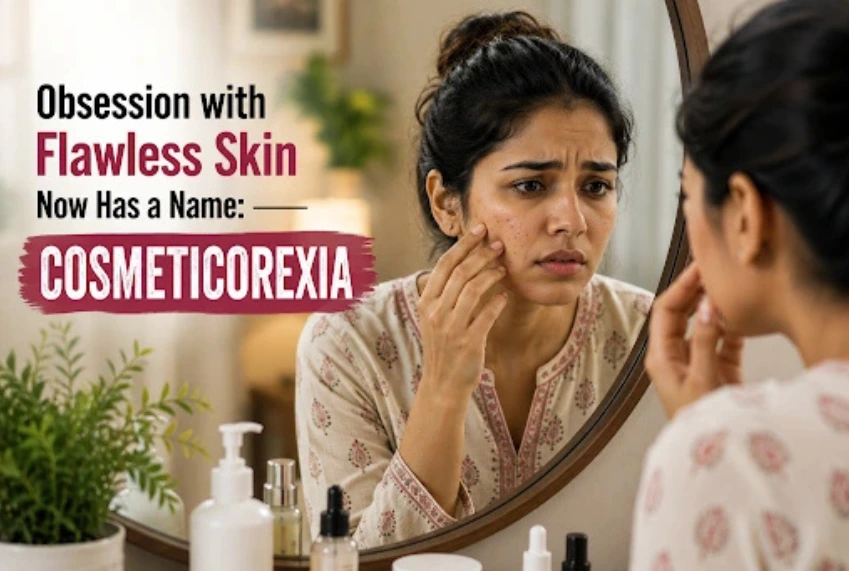
Healthy skin care is an important part of overall well-being. Cleansing, moisturizing, wearing sunscreen, and seeking treatment for genuine skin conditions can improve both physical and emotional health. But when the desire for perfect skin turns into an obsession, it starts to affect something far more important than appearance — it begins to erode mental health, relationships, finances, and overall quality of life.
This growing phenomenon is increasingly being referred to as Cosmeticorexia — a term used to describe an unhealthy preoccupation with achieving flawless skin or an idealized appearance through excessive skincare routines, cosmetic treatments, and constant appearance monitoring. Cosmeticorexia is not currently recognized as an official psychiatric diagnosis, but mental health professionals widely acknowledge that the behaviors associated with it often overlap with conditions such as Body Dysmorphic Disorder (BDD), obsessive-compulsive traits, anxiety disorders, and perfectionism.
In a world shaped by beauty influencers, filtered selfies, AI-enhanced images, and increasingly unrealistic beauty standards, many people feel constant pressure to look "perfect." This blog takes a closer look at Cosmeticorexia — what causes it, how to recognize it, the psychological toll it takes, and the steps that can help build a healthier, more sustainable relationship with skin and self-image.
What Is Cosmeticorexia?
Cosmeticorexia refers to an excessive obsession with achieving flawless skin or physical perfection through skincare products, cosmetic procedures, and beauty routines. It differs from ordinary skincare enjoyment in a fundamental way: people who simply enjoy skincare as a form of self-care look forward to their routine and feel relaxed by it, while those experiencing Cosmeticorexia often feel trapped by it.
They may spend several hours each day checking or treating their skin, feel genuinely anxious if they miss a step in their routine, and constantly switch products in search of an elusive "perfect" result. They tend to fixate on perceived flaws that other people barely notice, if at all, and over time begin to believe that their appearance determines their self-worth. What starts as healthy self-care gradually shifts into compulsive behavior that interferes with daily functioning.
Why Is Cosmeticorexia Becoming More Common?
Several modern lifestyle factors are converging to make this a growing concern rather than an isolated issue.
Social media filters play perhaps the largest role. Beauty filters smooth skin, remove blemishes, reshape facial features, and quietly reset what people consider "normal." Repeated exposure to these filtered images can make natural, ordinary skin start to feel unacceptable by comparison. A college student, for instance, might spend hours editing selfies before posting them online, only to gradually come to believe that her real skin looks wrong — even though it is perfectly healthy.
Influencer culture compounds this problem. Many influencers promote elaborate, multi-step skincare routines involving dozens of products, which quietly teaches followers to equate more products with better skin, to treat every blemish as a problem requiring intervention, and to see daily cosmetic procedures as a baseline necessity rather than an occasional indulgence.
Constant advertising adds another layer of pressure. The beauty industry introduces new creams, serums, masks, lasers, and treatments almost every week, and marketing often creates the impression that flawless skin is both achievable and expected — that anything less reflects a personal failure to try hard enough.
Comparison culture is arguably the emotional engine behind all of this. People naturally compare themselves with celebrities, influencers, coworkers, and friends, and this continuous comparison tends to produce lower self-esteem, chronic dissatisfaction with one's own appearance, and excessive spending in pursuit of an unattainable standard.
Finally, fear of aging drives much of the anxiety around skin. Many people become disproportionately worried about wrinkles, pigmentation, pores, or fine lines, and rather than accepting these as normal parts of getting older, they pursue an endless cycle of cosmetic treatments that never quite delivers lasting satisfaction.
Healthy Skin Care vs. Cosmeticorexia
The line between healthy skincare and Cosmeticorexia is not about how many products someone uses or how much they care about their appearance — it is about control. Someone with a healthy relationship to skincare cleanses appropriately, uses products as intended, accepts the occasional blemish without alarm, enjoys the ritual of their routine, and can miss a day here and there without any real distress.
Someone experiencing Cosmeticorexia, by contrast, may wash their face repeatedly throughout the day, layer on dozens of products at once, panic over a single small blemish, feel that their routine is a rigid obligation rather than a pleasure, experience real anxiety when it's interrupted, and keep buying new products in a restless search for perfection that never arrives. In short, healthy skincare improves a person's life, while Cosmeticorexia begins to control it.
Common Signs and Symptoms
Recognizing the warning signs early can prevent the emotional distress from deepening. One of the clearest indicators is excessive mirror checking — some people examine their face every fifteen minutes or so throughout the day, scanning for new blemishes under different lighting conditions. Closely related is the tendency to spend hours on skincare, with morning and evening routines stretching far beyond what any dermatological benefit would require.
Frequent product switching is another telling sign: instead of giving a product time to actually work, someone may abandon it after a few days in favor of whatever new item recently received glowing online reviews. This is often accompanied by an outsized obsession with tiny imperfections — minor pores, freckles, scars, or pigmentation that would go entirely unnoticed by others become sources of genuine distress.
In more advanced cases, people may pursue excessive cosmetic procedures — repeated chemical peels, laser treatments, Botox, fillers, or microneedling — without any real medical necessity, simply chasing a sense of improvement that never feels complete. Appearance-related anxiety can grow severe enough that social events are avoided altogether because of perceived skin flaws, and constant reassurance-seeking becomes a daily habit, with repeated questions like "Can you see this pimple?" or "Does my skin look uneven?" Underlying all of this is a pattern of emotional distress in which someone's mood rises and falls depending entirely on how their skin happens to look on a given day.
Psychological Factors Behind Cosmeticorexia
Cosmeticorexia rarely develops in isolation — it is almost always connected to deeper emotional patterns. Perfectionism is one of the most common threads: people with perfectionistic tendencies often believe that every flaw, whether in their work or their appearance, must be corrected, and this mindset extends naturally from academics or career into how they view their skin. Low self-esteem plays a similar role, particularly when someone's sense of self-worth becomes tightly bound to their physical appearance, so that even a small skin issue starts to feel like a personal failure.
Anxiety is another major driver, turning appearance-related worries into repetitive, difficult-to-control thought loops. In some cases, Cosmeticorexia behaviors may actually be an expression of Body Dysmorphic Disorder, a condition in which perceived flaws are exaggerated or entirely imagined — someone might genuinely believe their pores are enormous, for example, even though others see completely normal skin. Underlying many of these patterns is a broader tendency toward obsessive thinking, where appearance-related thoughts become intrusive and repetitive, making it genuinely difficult for the person to focus on anything else.
The Emotional and Financial Toll
The impact of Cosmeticorexia extends well beyond the skin itself. Emotionally, it can contribute to chronic stress, anxiety, depression, shame, social withdrawal, reduced confidence, and strain on personal relationships. Over time, the psychological suffering caused by the obsession often becomes far greater than the original appearance concern that started it.
The financial cost can be just as significant. Many people spend considerable sums on premium skincare products, imported cosmetics, frequent dermatology consultations, cosmetic procedures, and beauty devices — sometimes without ever finishing a single product before moving on to the next. It is not uncommon for someone earning a modest income to spend a substantial portion of their monthly earnings on skincare items they barely use, driven less by need than by the hope that the next purchase will finally deliver the results they're chasing.
There is also a physical irony at play: excessive skincare can actually worsen skin health rather than improve it. Overusing active ingredients like retinol, exfoliating acids, or vitamin C, or layering too many products at once, can damage the skin barrier and lead to irritation, allergic reactions, dryness, acne flare-ups, and long-term sensitivity — the very outcomes the person was trying so hard to avoid.
Real-Life Examples
Consider Riya, a college student who begins watching skincare videos and starts with a single cleanser. Within six months, she owns four cleansers, five serums, three toners, and multiple exfoliants. She spends two hours every night applying products and becomes visibly distressed whenever a new pimple appears — to the point that her studies begin to suffer because of constant appearance-related worry.
Or consider Amit, a corporate professional whose anxiety spikes before every meeting because he is convinced that everyone notices his faint acne scars. He repeatedly books expensive laser sessions despite dermatologists reassuring him that his skin is healthy, and eventually he starts avoiding presentations altogether out of embarrassment.
Then there's Neha, who compares herself with influencers every day and edits every selfie before posting it. Over time, she becomes uncomfortable appearing in public without makeup, having convinced herself that her real skin looks "terrible" — a belief with little basis in how others actually perceive her.
Who Is at Greater Risk?
While anyone can experience Cosmeticorexia, certain groups tend to be more vulnerable, including teenagers and young adults, heavy social media users, beauty influencers, and people who already struggle with perfectionism, anxiety disorders, or Body Dysmorphic Disorder. People who frequently undergo cosmetic procedures are also at higher risk, since each treatment can create pressure to pursue the next one in search of ever-elusive satisfaction.
Can Cosmeticorexia Affect Men?
Absolutely. While beauty marketing has traditionally targeted women, a growing number of men are becoming preoccupied with acne, pores, beard appearance, anti-aging treatments, skin whitening, and cosmetic procedures. Men often hesitate to seek help because of the stigma surrounding male grooming concerns, which can allow symptoms to worsen quietly over time.
How Is Cosmeticorexia Different from Body Dysmorphic Disorder?
The two conditions share meaningful overlap but are not identical. Body Dysmorphic Disorder is a recognized mental health disorder characterized by intense distress about perceived appearance flaws. Cosmeticorexia, on the other hand, is a more informal term commonly used to describe excessive cosmetic or skincare obsession — and in some individuals, it may represent behaviors associated with BDD, obsessive-compulsive tendencies, or anxiety rather than a distinct diagnosis in its own right. A mental health professional is best positioned to determine what's really underlying a person's symptoms and to recommend the most appropriate treatment.
When Should You Seek Professional Help?
It's worth consulting a mental health professional if appearance-related worries occupy several hours of the day, if social situations are being avoided because of skin concerns, or if the skincare routine itself has become a source of significant distress rather than comfort. Other signals include cosmetic procedures that never seem to bring satisfaction, persistent feelings of depression or anxiety tied to appearance, noticeable strain on relationships or work performance, and an inability to stop checking mirrors throughout the day. Early intervention generally leads to far better outcomes than waiting for the pattern to resolve on its own.
Treatment Options
Treatment approaches depend on each person's specific symptoms and the psychological factors driving them. The process typically begins with a psychological assessment, in which a psychiatrist or psychologist evaluates anxiety, depression, perfectionism, obsessive thoughts, and body image concerns to understand the full picture.
Cognitive Behavioral Therapy (CBT) is a psychological therapy that may be helpful for some people experiencing excessive appearance-related concerns or obsessive thoughts. It helps individuals better understand and cope with these concerns while encouraging them to recognize and re-evaluate unrealistic beliefs about their appearance. CBT can also help reduce repetitive behaviors, such as constantly checking the skin or face, improve self-esteem, and promote healthier, more balanced thinking patterns.
If a person experiences significant anxiety, obsessive thoughts, or symptoms of depression, a mental health professional may assess their individual needs and discuss appropriate care options. Depending on the person's condition, these may include therapy, medication, or a combination of both.
Mindfulness techniques can be a valuable complement to therapy, encouraging people to observe appearance-related thoughts without immediately reacting to them, which naturally reduces the urge toward repetitive checking. Limiting social media exposure often makes a meaningful difference as well; reducing exposure to heavily edited images — by unfollowing unrealistic beauty accounts, following dermatologists who share educational and realistic content, and simply cutting down daily screen time — can noticeably improve body satisfaction over time.
Building a Healthier Relationship with Your Skin
Moving away from the pursuit of perfection starts with accepting that pores, texture, fine lines, and occasional acne are simply normal features of human skin, not flaws to be eliminated. Keeping a routine simple — typically a gentle cleanser, a moisturizer, sunscreen, and a targeted treatment only where genuinely needed — tends to serve skin far better than piling on dozens of products, since more products rarely translate into better results.
It also helps to consciously resist the pull of constant comparison by remembering that filters change appearances, professional lighting hides imperfections, and a large share of the images people scroll past every day have simply been edited. Beyond the skin itself, focusing on overall wellness — balanced nutrition, adequate hydration, good sleep, stress management, and regular physical activity — tends to do more for both skin health and mental well-being than any single product ever could. Perhaps most importantly, practicing self-compassion by gently reminding yourself that your skin does not determine your worth can go a long way toward breaking the cycle of self-criticism that fuels Cosmeticorexia in the first place.
Final Thoughts
Taking care of your skin is a healthy habit, but chasing impossible perfection can come at a real emotional cost. Cosmeticorexia illustrates how easily modern beauty standards, social media, and constant comparison can transform a simple skincare routine into a source of ongoing anxiety and distress.
Healthy skin is not flawless skin — it is skin that is cared for realistically, without obsession. Learning to accept natural imperfections, stepping back from constant comparison, and seeking professional support when appearance concerns start to feel overwhelming are all meaningful steps toward better mental health. As Dr. Pranshu Agarwal notes, addressing the emotional roots behind these concerns is often the real turning point in recovery.
If worries about your skin are taking over your thoughts, affecting your confidence, or disrupting your daily life, it may help to speak with a qualified mental health professional. Addressing the emotional roots behind these concerns can help you build a healthier relationship with both your appearance and yourself. True confidence, after all, comes not from perfect skin, but from self-acceptance, emotional well-being, and the recognition that your value extends far beyond how you look.
FAQs
1. Is Cosmeticorexia an official mental health disorder?
No. Cosmeticorexia is not officially recognized as a mental health disorder. However, it may be associated with conditions such as Body Dysmorphic Disorder (BDD), anxiety, obsessive-compulsive traits, or perfectionism.
2. Can excessive skincare damage the skin?
Yes. Overusing skincare products or combining too many active ingredients can damage the skin barrier, causing irritation, dryness, sensitivity, and breakouts.
3. Can Cosmeticorexia affect men as well as women?
Yes. Cosmeticorexia can affect anyone, regardless of gender. Many men also experience excessive concerns about acne, aging, skin tone, or other appearance-related issues.
4. When should someone seek professional help?
If concerns about your appearance are causing significant emotional distress, affecting your daily life, relationships, work, or self-confidence, it's a good idea to consult a qualified mental health professional.